


An important part of “Healing Our Culture” is studying chapters of our history which have been hidden or omitted from the formal educational curriculum, especially when those topics involve the enslavement and oppression of different groups of people. We need to more thoroughly and accurately understand our history, including the history of settler colonialism and white supremacy in the United States specifically, if we hope to help heal the wounds and bind up the legacy of trauma and suffering which so many people have experienced and continue to experience in the Americas.
To prepare for our evening Zoom small group meeting for Project 1526, I found 14 YouTube videos which share information and ideas about our theme this week, “The Great Dismal Swamp: Maroons in the Land Between.” I watched three of them to select one I shared during our actual Zoom call tonight. The videos I watched prior to our meetup were:
The Hidden Black Society They Don’t Teach You About (PBS Origins, 12 min, 20 sec)
Inside the Historic Swamp Refuge for African-American Slaves (Great Big Story, 4 min)
The secret society of the Great Dismal Swamp - Dan Sayers (TEDed, 5.5 min)
I chose to share the shortest of these videos, Inside the Historic Swamp Refuge for African-American Slaves (Great Big Story, 4 min), because I like the actual video footage in the segment (as opposed to others which feature more animation) as well as the interview segments with a researcher and maroon descendant.
To create a slideshow about some of these ideas, including relatively recent archeology and anthropological research which has uncovered physical evidence of the indigenous communities as well as Maroon communities in the Dismal Swamp, I used a web tool to copy and download transcripts of six of these videos. (The first six currently in the YouTube playlist, which include several hour-length lectures by academics and researchers.) I then created a draft version of our slideshow for tonight’s meeting using Gemini Notebook, with this prompt, which Claude helped me refine:
Create a slide presentation summarizing the key ideas from these 6 video transcripts about the Great Dismal Swamp, focusing on the maroon communities who found freedom and refuge there.
Context: This is for a spiritual formation small group meeting on September 13th, studying “The Great Dismal Swamp: Maroons in the Land Between” (see attached week11.pdf for background). Participants have some familiarity with the topic but haven’t watched the videos themselves.
For each slide:
- Synthesize ideas across the different experts and narrators rather than summarizing one video at a time — where sources agree, note the shared theme; where they offer distinct or contrasting perspectives, capture that too.
- Attribute key insights or quotes to the specific speaker or expert who offered them.
- Use clear, engaging language appropriate for a thoughtful adult discussion group, not an academic lecture.
Structure:
1. A title slide framing the swamp as a place of resistance, survival, and community
2. 4-6 slides covering major themes (e.g., what maroon communities were, how they survived, what freedom meant there, how this history has been remembered or overlooked)
3. A closing slide with 3-4 open-ended discussion questions connecting these themes to our small group’s spiritual formation focus
Tone: Treat the subject with the same weight and respect it deserves given its roots in slavery and resistance — engaging and accessible, but never flippant, and avoid reducing complex lived experiences to simplistic takeaways.
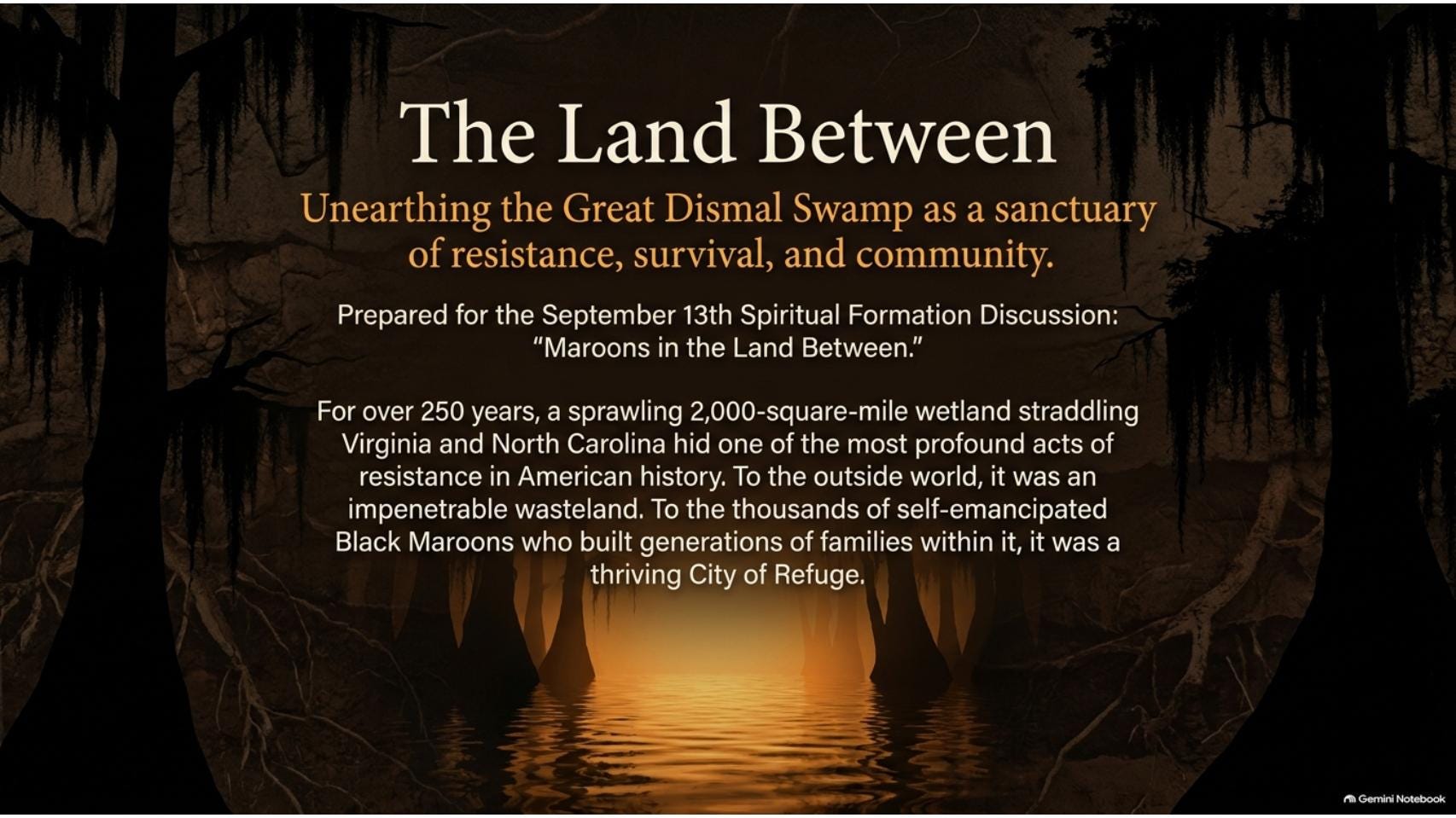
Paired with the interactive liturgies of our week 11 curriculum, these media elements provided a good overview for our gathering and discussions tonight.
I’ll share observations about two other videos included in the YouTube playlist I created.
The relatively recent video (August 21, 2026) “The Maroons of the Great Dismal Swamp: 200 Years Off the Grid” is outstanding as well. Part of its focus is for descendants of the maroons who are working to trace their ancestry in the area, and do not have records of their ancestors prior to the 1870 US census.
The author of the NYTN channel, Danielle Romero, describes her channel this way:
What did America pass down to us and what do we do with it now?
Join me for historical deep dives, cultural archaeology, and family stories that challenge what we thought we knew.
I’m Danielle Romero. M. Ed., and my content is all about exploring the nuances of American identity and unearthing hidden historical narratives. My great grandmother Lola left her heritage behind in Louisiana when she moved to NY in the 1930s. I decided to uncover our family story and begin finding our roots. I’m still on the journey of hidden heritage, genealogy and finding out how our family history fits in the context of community history!
I enjoyed her video on The Great Dismal Swamp and am glad to have found her channel.
I’m troubled, however, by another channel I discovered in today’s YouTube research, that is entirely AI generated and does not provide any channel information or source citations. The channel is “Slavery’s Dark Past,” and as of today it just has 599 subscribers. The related video to our topic today caught my eye initially because the title is currently missing the leading “F,” so its title is, “orgotten History: The Enslaved People Who Hid in the Great Dismal Swamp.” I’ve labeled its screenshot “AI Animation Slop History Channel on YouTube.” The missing “F” in the title is another example of sloppy media creation and lack of attention to detail.
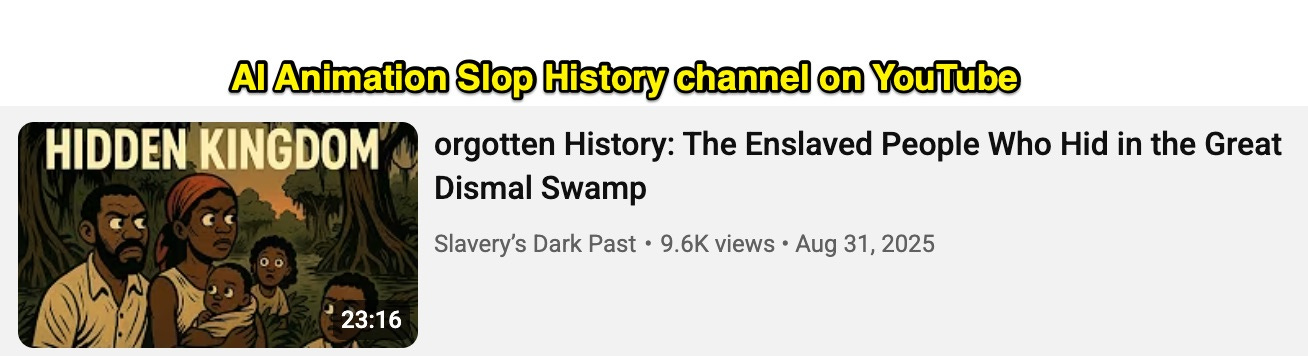
If there is a better way to label or categorize YouTube channels like this please let me know. I need to write more about this on my “Media Literacy with Wes” Substack, but I wanted to include a note about it here because of its relevance to our studies and conversations this evening for Project 1526.
The channel’s description does not provide any hyperlinks for the author or sponsoring organization, and it does not provide any helpful insights to help visitors judge credibility or trustworthiness:
"Slavery’s Dark Past" is a channel dedicated to uncovering the untold stories, hidden histories, and lasting impact of slavery across the world. Through satirical art, dark storytelling, and thought-provoking narratives, we explore the brutal realities of the transatlantic slave trade, the lives of the enslaved, and how oppression shaped modern society.
Our goal is not just to remember history, but to challenge the way it’s told — blending education with a unique, surreal style that leaves a lasting impression. Expect documentaries, deep-dive analysis, and creative storytelling that reveal the human cost behind empires, economies, and cultures.
This is history unfiltered.
This is memory made visual.
This is Slavery’s Dark Past.
It is both important and very difficult to “fact check” fast paced videos, but thankfully transcripts and AI tools can help. I wrote about this in March 2026 in the post, “Fact Checking a Misleading Iran War Meme.”
I do appreciate and enjoy some of the capabilities which AI tools offer me as a learner and teacher today, but I am very aware of the problems and challenging issues they also present. I don’t have the documentation at my fingertips right now, but I have previously seen and noticed similar AI-generated YouTube channels that are basically impossible to laterally read, and provide zero information about their sources or authorship.
We continue to live in a ‘wild west’ of media and information, but this environment also affords us positive opportunities to access and share high quality media examples. Some of the videos I’ve shared in this post fit that description.
If these resources and this information were informative and/or helpful to you, please let me know! Consider following me and subscribing to my other advocacy publications, and connecting with me on other social media platforms.
Also be sure to check out Project 1526. More information is available on my “Confronting Whiteness” website.